What Is TensorFlow?
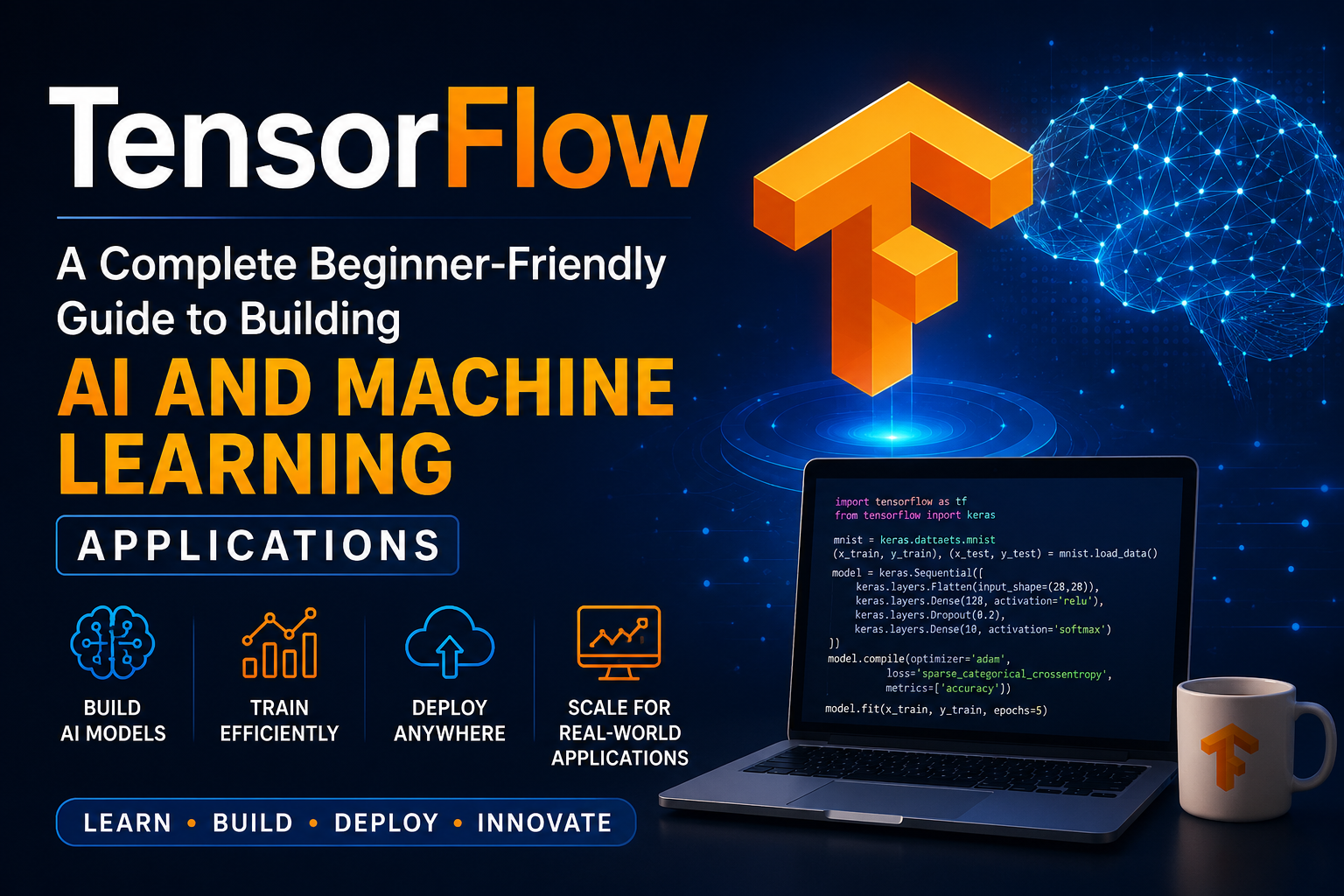
TensorFlow is an open-source software library designed for numerical computation and machine learning. It allows developers to create computational graphs that process large amounts of data efficiently. The framework supports deep learning, traditional machine learning, and advanced artificial intelligence applications.
The name TensorFlow comes from two concepts. A tensor is a multidimensional array used to represent data, while flow refers to the movement of data through a computational graph. Together, these concepts enable efficient processing and training of machine learning models.
TensorFlow supports multiple programming languages, including Python, JavaScript, C++, and Java. However, Python remains the most widely used language due to its simplicity and extensive machine learning ecosystem.
Why TensorFlow Is Popular
TensorFlow has gained widespread adoption because it offers powerful capabilities while remaining accessible to beginners. Organizations of all sizes use TensorFlow to build AI solutions that solve real-world problems.
- Open-source and free to use
- Backed by Google and a large developer community
- Supports both machine learning and deep learning
- Scales from small projects to enterprise applications
- Compatible with CPUs, GPUs, and TPUs
- Provides tools for model deployment and monitoring
- Extensive documentation and learning resources
How TensorFlow Works
TensorFlow operates by processing data through computational graphs. These graphs consist of nodes and edges. Nodes represent mathematical operations, while edges represent the flow of data between operations.
When building a machine learning model, developers define layers, specify input data, and establish relationships between different components. TensorFlow then manages the calculations required to train the model and optimize its performance.
The general workflow includes collecting data, preprocessing information, designing a model architecture, training the model, evaluating performance, and deploying the solution for real-world use.
Core Components of TensorFlow
Understanding TensorFlow becomes easier when you become familiar with its core components.
- Tensors: Multidimensional arrays used to store data.
- Operations: Mathematical functions performed on tensors.
- Graphs: Structures that organize computational operations.
- Variables: Parameters that are updated during training.
- Models: Machine learning architectures built using TensorFlow.
- Datasets: Input data used for training and testing.
These components work together to create efficient and scalable machine learning pipelines.
Key Features of TensorFlow
TensorFlow includes a wide range of features that make AI development more efficient.
- Flexible Architecture: Supports multiple platforms and environments.
- Automatic Differentiation: Simplifies gradient calculations for neural networks.
- Distributed Training: Enables training across multiple devices.
- Visualization Tools: TensorBoard provides detailed insights into model performance.
- Production Deployment: Supports deployment on servers, cloud environments, mobile devices, and browsers.
- Hardware Acceleration: Optimized for GPUs and TPUs.
These capabilities help developers build sophisticated machine learning systems while reducing complexity.
TensorFlow Ecosystem
The TensorFlow ecosystem contains several specialized tools and libraries that extend its functionality.
- TensorFlow Lite: Deploys machine learning models on mobile and edge devices.
- TensorFlow Serving: Manages production deployment of trained models.
- TensorBoard: Visualizes training metrics and model performance.
- TensorFlow Hub: Provides reusable machine learning modules.
- Keras: High-level API for building neural networks quickly.
- TensorFlow Extended (TFX): Supports end-to-end machine learning pipelines.
This ecosystem allows organizations to develop, deploy, and manage AI systems efficiently.
TensorFlow and Deep Learning
Deep learning is one of TensorFlow’s strongest capabilities. Deep learning models use artificial neural networks with multiple layers to identify patterns and make predictions.
TensorFlow simplifies the creation of neural networks by providing built-in layers, activation functions, optimization algorithms, and training tools. Developers can create models ranging from simple feedforward networks to advanced architectures such as convolutional neural networks and recurrent neural networks.
Deep learning applications built with TensorFlow can perform tasks such as image classification, speech recognition, language translation, and autonomous decision-making.
Real-World Applications of TensorFlow
TensorFlow powers a wide range of applications across industries.
- Healthcare: Disease detection, medical imaging, and predictive diagnostics.
- Finance: Fraud detection, risk assessment, and market forecasting.
- Retail: Product recommendations and customer behavior analysis.
- Education: Personalized learning systems and intelligent tutoring platforms.
- Manufacturing: Predictive maintenance and quality control.
- Transportation: Autonomous vehicles and route optimization.
- Marketing: Customer segmentation and campaign optimization.
These examples demonstrate the versatility and scalability of TensorFlow in solving business challenges.
Benefits of Using TensorFlow
Organizations and developers choose TensorFlow because of its numerous advantages.
- Strong community support and active development
- Excellent scalability for large datasets
- Cross-platform deployment capabilities
- Comprehensive documentation and tutorials
- Integration with cloud computing platforms
- Efficient handling of complex neural networks
- Support for research and production environments
These benefits make TensorFlow suitable for startups, enterprises, researchers, and students.
Getting Started with TensorFlow
Beginners can start learning TensorFlow by understanding fundamental machine learning concepts and practicing with small projects. The recommended learning path includes learning Python, studying basic statistics, exploring machine learning fundamentals, and then building simple TensorFlow models.
A typical beginner project might involve classifying handwritten digits, predicting house prices, or analyzing customer data. These projects help users understand data preprocessing, model training, evaluation, and deployment.
As experience grows, developers can move on to advanced deep learning applications involving computer vision, natural language processing, and reinforcement learning.
Best Practices for TensorFlow Development
Following best practices helps improve model accuracy, efficiency, and maintainability.
- Use clean and well-structured datasets.
- Split data into training, validation, and testing sets.
- Monitor model performance using TensorBoard.
- Prevent overfitting through regularization techniques.
- Optimize hyperparameters systematically.
- Document experiments and results.
- Use version control for code and models.
- Continuously evaluate deployed models.
These practices contribute to reliable and scalable machine learning solutions.
Challenges and Limitations
Although TensorFlow is powerful, it also presents certain challenges. Beginners may initially find the framework complex due to its extensive features and terminology. Training large models can require significant computational resources, and model optimization often involves experimentation.
Despite these challenges, TensorFlow continues to improve through regular updates, enhanced documentation, and simplified APIs such as Keras.
Future of TensorFlow
The future of TensorFlow remains promising as artificial intelligence continues to evolve. Emerging technologies such as generative AI, edge AI, federated learning, and advanced neural architectures are expanding TensorFlow’s capabilities. Businesses increasingly rely on AI-driven insights, creating greater demand for frameworks that support scalable machine learning development.
As hardware becomes more powerful and AI adoption grows, TensorFlow is expected to remain one of the leading frameworks for innovation in machine learning and deep learning.
Frequently Asked Questions (FAQ)
1. What is TensorFlow used for?
TensorFlow is used for machine learning, deep learning, artificial intelligence, computer vision, natural language processing, predictive analytics, and recommendation systems.
2. Is TensorFlow free?
Yes. TensorFlow is an open-source framework available free of charge.
3. Is TensorFlow beginner-friendly?
Yes. TensorFlow provides extensive documentation, tutorials, and the Keras API, making it accessible for beginners.
4. What programming language is best for TensorFlow?
Python is the most commonly used programming language for TensorFlow development.
5. What is the difference between TensorFlow and Keras?
Keras is a high-level API integrated into TensorFlow that simplifies neural network development.
6. Can TensorFlow run on mobile devices?
Yes. TensorFlow Lite allows machine learning models to run efficiently on smartphones and edge devices.
7. Does TensorFlow support GPU acceleration?
Yes. TensorFlow supports GPUs and TPUs for faster model training and inference.
Conclusion
TensorFlow is a powerful and versatile framework that has become a cornerstone of modern artificial intelligence development. Its ability to support machine learning, deep learning, and production-scale AI applications makes it valuable for developers, researchers, and organizations worldwide. With extensive tools, strong community support, and continuous innovation, TensorFlow provides an excellent foundation for building intelligent systems. Whether you are a beginner exploring machine learning or an experienced professional developing advanced AI solutions, TensorFlow offers the flexibility, scalability, and performance needed to turn ideas into reality.

Recent Comments