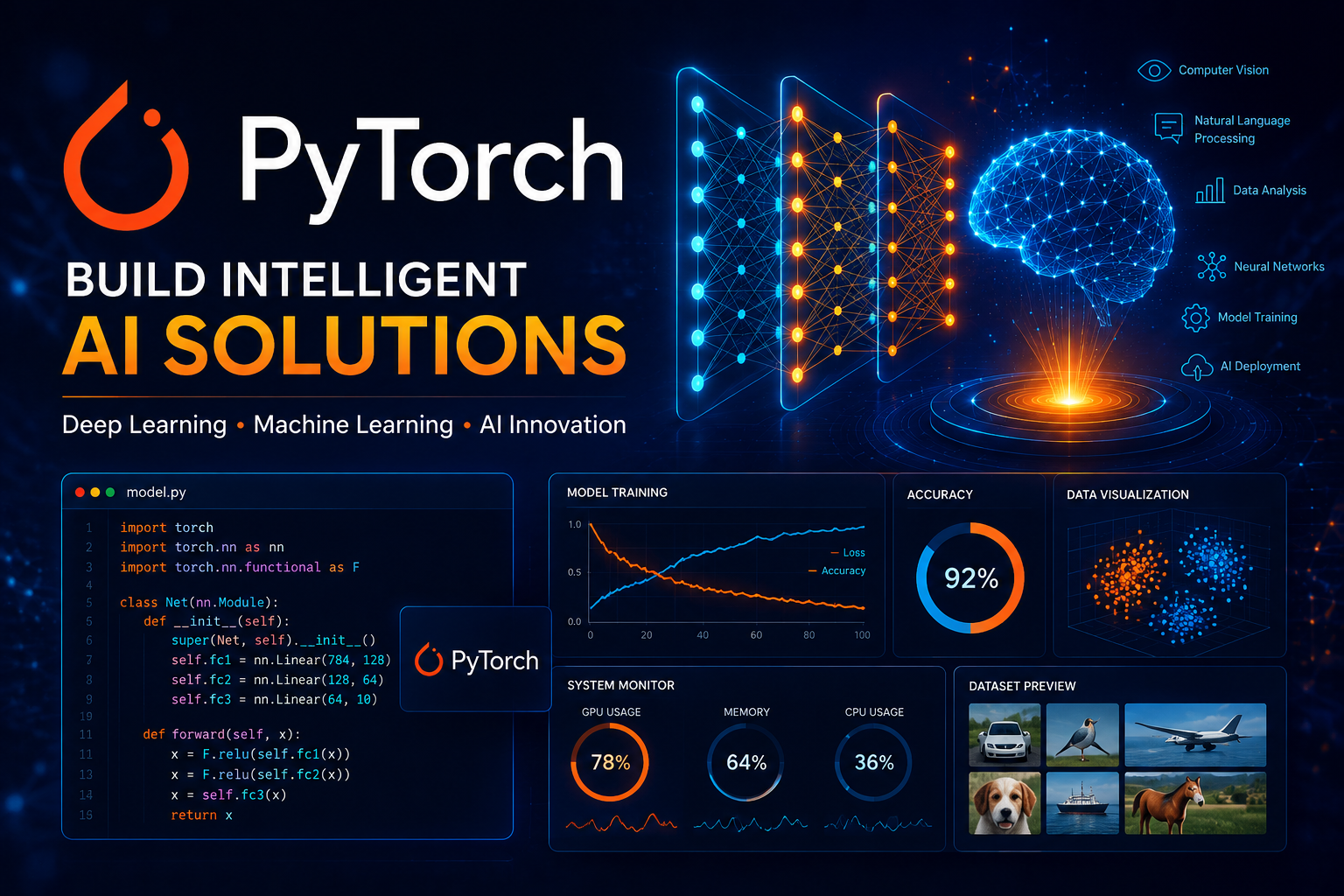
Artificial Intelligence (AI) and Machine Learning (ML) have become essential technologies across industries, powering applications such as recommendation systems, image recognition, natural language processing, autonomous vehicles, and predictive analytics. To build these intelligent systems efficiently, developers rely on powerful frameworks. One of the most popular and widely adopted frameworks today is PyTorch.
Developed by Facebook’s AI Research team, PyTorch has gained significant popularity among researchers, developers, and enterprises because of its flexibility, simplicity, and strong support for deep learning projects. Whether you are a student learning AI for the first time or a professional developer looking to create advanced machine learning models, PyTorch provides an excellent platform to start your journey.
In this comprehensive guide, you will learn what PyTorch is, how it works, its key features, benefits, architecture, applications, and best practices for building modern AI solutions.
What is PyTorch?
PyTorch is an open-source machine learning framework built on Python and the Torch library. It provides tools and libraries for building, training, and deploying deep learning models efficiently. PyTorch allows developers to create neural networks using an intuitive programming style that closely resembles standard Python code.
The framework is widely used in research and production environments because it offers dynamic computational graphs, GPU acceleration, automatic differentiation, and extensive support for deep learning tasks.
PyTorch supports multiple AI domains including:
- Computer Vision
- Natural Language Processing (NLP)
- Speech Recognition
- Reinforcement Learning
- Generative AI
- Predictive Analytics
- Time Series Forecasting
Why PyTorch is Popular
PyTorch has become one of the leading frameworks in artificial intelligence because it combines flexibility with performance. Developers appreciate its easy-to-understand syntax and ability to debug models efficiently.
- Simple and beginner-friendly interface
- Dynamic computation graphs
- Strong Python integration
- Extensive community support
- GPU acceleration for faster training
- Large ecosystem of tools and libraries
- Widely adopted by researchers and enterprises
Many cutting-edge AI models and research papers use PyTorch because it allows rapid experimentation and innovation.
Key Features of PyTorch
PyTorch includes numerous features that make AI development easier and more efficient.
- Dynamic Computational Graphs: Graphs are built during execution, enabling flexible model development.
- Automatic Differentiation: The Autograd engine automatically calculates gradients required for model training.
- GPU Support: CUDA integration enables faster processing on NVIDIA GPUs.
- Tensor Operations: Efficient multidimensional arrays similar to NumPy.
- Neural Network Modules: Pre-built layers and functions simplify model creation.
- Distributed Training: Train large models across multiple devices.
- Deployment Support: Tools for deploying models in production environments.
Understanding PyTorch Tensors
Tensors are the foundation of PyTorch. They are multidimensional arrays that store numerical data and perform mathematical operations efficiently.
Tensors are similar to NumPy arrays but provide additional capabilities such as GPU acceleration and automatic gradient tracking.
Common tensor operations include:
- Matrix multiplication
- Data transformation
- Statistical calculations
- Feature engineering
- Model parameter storage
Because tensors can run on GPUs, they significantly accelerate machine learning computations.
How PyTorch Works
PyTorch follows a straightforward workflow for developing machine learning models.
- Collect and prepare data
- Convert data into tensors
- Build a neural network architecture
- Define a loss function
- Select an optimizer
- Train the model
- Evaluate performance
- Deploy the trained model
This workflow enables developers to create powerful AI applications efficiently while maintaining full control over model behavior.
Building Neural Networks with PyTorch
One of the primary reasons developers choose PyTorch is its excellent support for neural network development. The framework provides the torch.nn module, which includes layers, activation functions, loss functions, and optimization tools.
A typical neural network consists of:
- Input Layer
- Hidden Layers
- Activation Functions
- Output Layer
PyTorch simplifies the implementation of these components, allowing developers to focus on solving business problems instead of writing low-level mathematical code.
PyTorch Ecosystem
The PyTorch ecosystem includes several powerful tools designed to support every stage of AI development.
- TorchVision: Computer vision datasets, transforms, and models.
- TorchText: Natural language processing utilities.
- TorchAudio: Audio processing and speech recognition tools.
- TorchServe: Model deployment and serving.
- PyTorch Lightning: Simplified deep learning workflows.
- TorchRec: Recommendation system development.
These libraries accelerate development and help developers build sophisticated AI solutions quickly.
Applications of PyTorch
PyTorch powers numerous real-world applications across industries.
- Image Classification: Detect and classify objects in images.
- Object Detection: Identify multiple objects within images and videos.
- Natural Language Processing: Chatbots, translation, sentiment analysis, and text generation.
- Healthcare: Medical image analysis and disease prediction.
- Finance: Fraud detection and risk assessment.
- Recommendation Systems: Personalized content and product suggestions.
- Autonomous Vehicles: Environment perception and decision-making.
Its flexibility makes PyTorch suitable for both research prototypes and enterprise-grade applications.
Advantages of Using PyTorch
PyTorch offers several advantages compared to traditional machine learning frameworks.
- Easy to learn and use
- Excellent debugging capabilities
- Flexible model architecture development
- Strong research community support
- High-performance GPU acceleration
- Rapid experimentation and prototyping
- Seamless Python integration
- Scalable deployment options
These benefits make PyTorch a preferred choice for organizations investing in artificial intelligence initiatives.
PyTorch vs TensorFlow
PyTorch and TensorFlow are the two dominant deep learning frameworks. While both are highly capable, they differ in certain areas.
- PyTorch is generally easier for beginners.
- PyTorch uses dynamic computational graphs.
- TensorFlow offers extensive enterprise deployment tools.
- PyTorch is highly popular in academic research.
- Both frameworks support GPU acceleration and large-scale training.
For beginners, PyTorch is often recommended due to its intuitive syntax and straightforward debugging experience.
Best Practices for Learning PyTorch
If you are new to machine learning, following best practices can accelerate your learning process.
- Learn Python fundamentals first.
- Understand linear algebra and basic statistics.
- Start with simple neural networks.
- Practice using real-world datasets.
- Experiment with pre-trained models.
- Study deep learning concepts gradually.
- Participate in AI communities and forums.
Consistent practice is the most effective way to build expertise in PyTorch and deep learning.
Future of PyTorch
The future of PyTorch looks extremely promising. The framework continues to evolve with improvements in performance, distributed training, deployment capabilities, and support for emerging AI technologies.
As generative AI, large language models, computer vision systems, and autonomous technologies continue to grow, PyTorch is expected to remain a leading platform for innovation. Many modern AI breakthroughs rely on PyTorch because of its flexibility and developer-friendly design.
Frequently Asked Questions (FAQ)
1. Is PyTorch suitable for beginners?
Yes. PyTorch is considered one of the most beginner-friendly deep learning frameworks because of its simple syntax and strong Python integration.
2. Is PyTorch free to use?
Yes. PyTorch is open-source and available free of charge for both personal and commercial projects.
3. Can PyTorch run on GPUs?
Yes. PyTorch supports CUDA-enabled GPUs, allowing significantly faster training and inference.
4. What programming language is used with PyTorch?
PyTorch primarily uses Python, making it accessible to a wide range of developers and data scientists.
5. Is PyTorch used in industry?
Absolutely. Many leading technology companies, startups, and research organizations use PyTorch to develop and deploy AI applications.
Conclusion
PyTorch has established itself as one of the most powerful and accessible frameworks for artificial intelligence and deep learning development. Its dynamic computational graphs, intuitive Python-based design, extensive ecosystem, and strong community support make it an ideal choice for beginners and experienced professionals alike.
Whether your goal is to build image recognition systems, intelligent chatbots, recommendation engines, or advanced generative AI applications, PyTorch provides the tools and flexibility needed to succeed. By learning PyTorch today, you can develop valuable skills that are increasingly in demand across the rapidly growing AI industry.
Recent Comments