
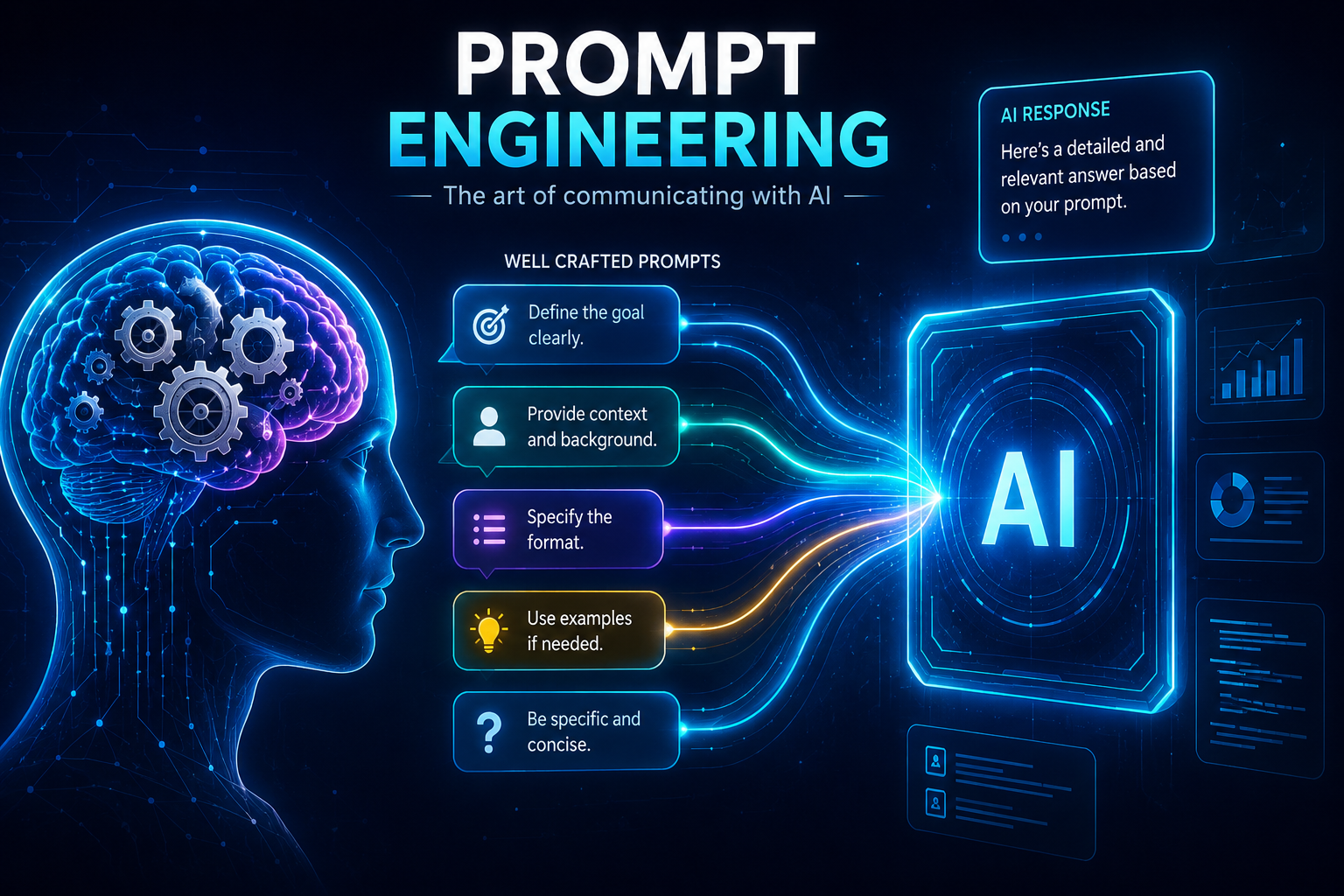
In today’s rapidly evolving technological landscape, Artificial Intelligence (AI) is no longer a futuristic concept but a present reality that is transforming industries and daily life. From generating creative text formats to answering complex questions, AI models are becoming increasingly sophisticated. However, unlocking the full potential of these powerful tools hinges on our ability to communicate with them effectively. This is where Prompt Engineering comes in.
You might have interacted with AI chatbots like ChatGPT, or used AI-powered image generators. You likely noticed that the quality of the output often depends heavily on the input you provide. This input, the instructions or questions you give to the AI, is called a prompt. Prompt Engineering is the discipline of designing and refining these prompts to elicit the desired responses from AI models. It’s the bridge between human intent and AI execution.
For beginners, the idea of “engineering” a prompt might sound daunting. But fear not! At its core, prompt engineering is about clear communication, logical thinking, and a touch of creativity. It’s a skill that can be learned and honed, empowering you to leverage AI more effectively for a myriad of tasks.
What Exactly is Prompt Engineering?
Prompt Engineering is the process of carefully crafting input (prompts) for AI models, particularly large language models (LLMs) and diffusion models, to guide them towards generating specific, accurate, and relevant outputs. It involves understanding how AI models process information and using that knowledge to design prompts that are:
- Clear and Concise: Ambiguity leads to unpredictable results.
- Specific and Detailed: The more information you provide, the better the AI can understand your needs.
- Contextually Rich: Providing background information helps the AI grasp the nuances of your request.
- Goal-Oriented: Knowing what you want to achieve is crucial for crafting an effective prompt.
Think of it like giving instructions to a highly intelligent but very literal assistant. If you’re vague, they might bring you the wrong thing. If you’re precise, they’ll get it right.
Why is Prompt Engineering So Important?
The rise of powerful AI models has democratized access to advanced capabilities. However, without effective prompt engineering, users may only scratch the surface of what these tools can do. Here’s why it’s becoming increasingly vital:
- Maximizing AI Performance: Well-crafted prompts unlock the full potential of AI models, leading to higher quality outputs and more accurate results.
- Improving Efficiency: Instead of endless trial and error, effective prompts reduce the time and effort required to get the desired outcome.
- Enhancing Creativity: Prompt engineering can be used to spark creative ideas, generate unique content, and explore new possibilities.
- Ensuring Safety and Ethics: Careful prompt design can help mitigate bias and prevent the generation of harmful or inappropriate content.
- Democratizing AI Use: By making AI more accessible and understandable, prompt engineering empowers a wider range of users to benefit from AI technologies.
As AI becomes more integrated into our workflows, the ability to communicate effectively with these systems will be a valuable, if not essential, skill.
The Fundamentals of Crafting Effective Prompts
For beginners, starting with the basics of prompt construction is key. Here are some fundamental principles to keep in mind:
1. Be Clear and Specific
Avoid vague language. Instead of asking “Write something about dogs,” try “Write a short, heartwarming story about a golden retriever puppy’s first day at the park, focusing on its playful interactions with other dogs.”
2. Provide Context
Give the AI background information to help it understand the situation. If you’re asking for a marketing email, specify the product, target audience, and desired tone (e.g., enthusiastic, professional).
3. Define the Output Format
Tell the AI exactly how you want the information presented. Do you need a bulleted list? A paragraph? A table? A poem? Specify the desired format.
4. Set Constraints and Guidelines
If there are limitations, like word count or specific keywords to include or avoid, clearly state them. For instance, “Write a blog post under 500 words, ensuring it mentions ‘artificial intelligence’ and ‘prompt engineering’ at least twice, but avoids jargon.”
5. Use Examples (Few-Shot Prompting)
For more complex tasks, providing one or more examples of the desired input-output pair can significantly improve the AI’s understanding. This is known as ‘few-shot prompting’.
6. Iterate and Refine
Prompt engineering is an iterative process. Your first prompt might not yield the perfect result. Don’t be discouraged. Analyze the AI’s response, identify what went wrong, and adjust your prompt accordingly. Small changes can often lead to big improvements.
Common Prompt Engineering Techniques for Beginners
Beyond the fundamentals, there are several techniques that can elevate your prompt engineering skills:
- Zero-Shot Prompting: This is the simplest form, where you ask the AI to perform a task without providing any examples. It relies entirely on the AI’s pre-existing knowledge. Example: \”Translate the following English text to French: ‘Hello, how are you?’\”
- One-Shot Prompting: Similar to zero-shot, but you provide a single example of the task. Example: \”Here is an example of a sentiment analysis: Text: \”I love this product!\” Sentiment: Positive. Now, analyze the sentiment of this text: \”This was a terrible experience.\””
- Few-Shot Prompting: As mentioned earlier, providing multiple examples. This is incredibly powerful for teaching the AI a specific style or format.
- Role-Playing: Instruct the AI to act as a specific persona. Example: \”Act as a seasoned travel agent. Recommend the best beach destinations for a family vacation in July, considering budget and activities.\”
- Chain-of-Thought (CoT) Prompting: Encourage the AI to break down its reasoning process step-by-step. This is particularly useful for complex problems or logical puzzles. Example: \”Let’s think step by step. If a train leaves station A at 2 PM traveling at 60 mph, and station B is 180 miles away, when will it arrive?\”
Prompt Engineering in Action: Practical Examples
Let’s illustrate these concepts with some practical examples:
Example 1: Creative Writing
Bad Prompt: Write a story.
Good Prompt: \”Write a short story (around 300 words) in the style of Edgar Allan Poe, about a lone lighthouse keeper who begins to hear whispers from the sea during a fierce storm. Focus on building suspense and a sense of isolation.\”
Example 2: Summarization
Bad Prompt: Summarize this article.
Good Prompt: \”Read the following article and provide a bullet-pointed summary of its main arguments and conclusions. Ensure the summary is no more than 100 words and suitable for a busy executive.\” [Paste Article Here]
Example 3: Code Generation
Bad Prompt: Write Python code.
Good Prompt: \”Write a Python function that takes a list of numbers as input and returns the average. Include docstrings explaining what the function does, its parameters, and what it returns.\”
The Future of Prompt Engineering
As AI models continue to evolve, prompt engineering will likely become more sophisticated. We may see:
- Automated Prompt Optimization: AI tools that help users automatically generate or refine prompts.
- More Intuitive Interfaces: Visual or conversational interfaces that make prompt engineering accessible to even non-technical users.
- Specialized Prompt Engineering: Different approaches and expertise for different AI models and tasks.
The demand for skilled prompt engineers is already growing, and it’s a field with significant potential for those who can master the art of communicating with AI.
Frequently Asked Questions (FAQ)
What is the most important aspect of prompt engineering?
Clarity and specificity are paramount. The more precise your instructions, the better the AI can understand and fulfill your request.
Do I need to be a programmer to be a prompt engineer?
Not necessarily. While a technical background can be helpful, strong communication skills, logical thinking, and an understanding of the AI’s capabilities are often more important for effective prompt engineering.
How can I practice prompt engineering?
The best way to practice is by actively using AI tools. Experiment with different prompts, observe the results, and learn from your iterations. Many platforms offer free tiers or trials.
Are there ethical considerations in prompt engineering?
Yes. Prompt engineers should be mindful of potential biases in AI models and strive to create prompts that encourage fair, unbiased, and ethical outputs. Responsible AI use is crucial.
Conclusion
Prompt Engineering is more than just typing questions into a chat window; it’s a powerful skill that unlocks the immense capabilities of Artificial Intelligence. By understanding the principles of clear communication, providing context, and iterating on your prompts, you can transform AI from a curious novelty into an indispensable tool.
Whether you’re a student, a creative professional, a developer, or simply someone curious about AI, investing time in learning prompt engineering will undoubtedly pay dividends. Start experimenting, embrace the iterative process, and discover the incredible possibilities that await when you learn to speak the language of AI.
Recent Comments