
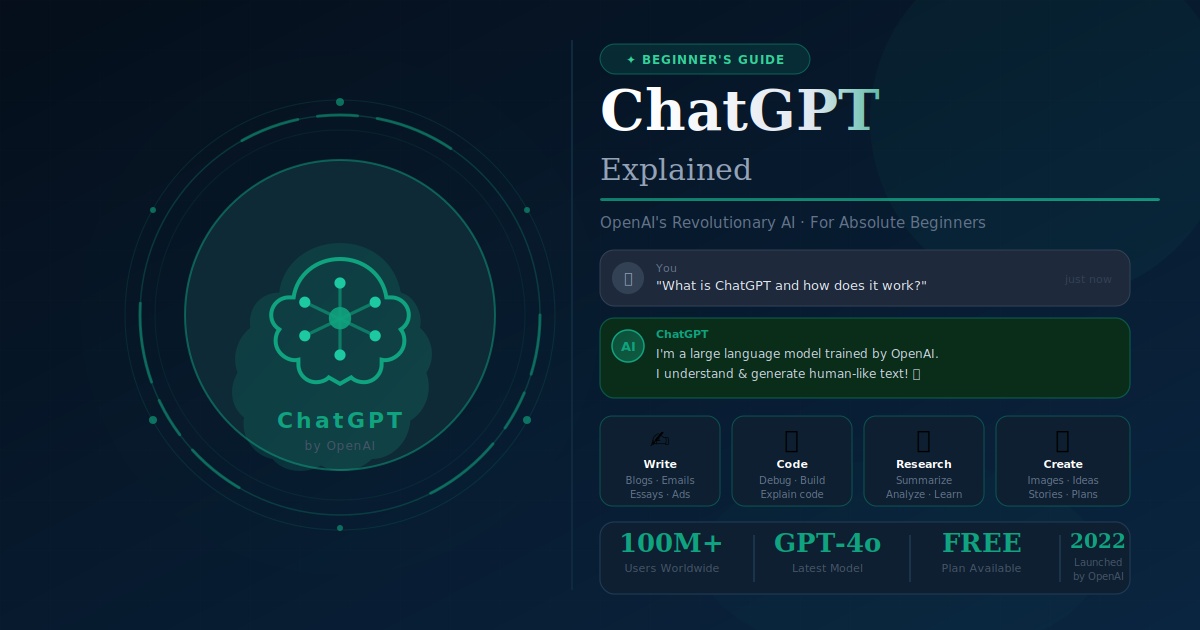
In the rapidly evolving world of technology, few developments have captured the public imagination quite like artificial intelligence (AI). At the forefront of this revolution is OpenAI, a research laboratory dedicated to ensuring that artificial general intelligence (AGI) benefits all of humanity. And perhaps their most widely recognized and accessible creation is ChatGPT. You’ve likely heard the buzz, seen the viral tweets, or even experimented with it yourself. But what exactly is ChatGPT, and why is it generating so much excitement?
For many, ChatGPT represents the first tangible encounter with a truly advanced AI. It’s capable of understanding and generating human-like text, engaging in conversations, writing creative content, and even assisting with complex tasks. This blog post is designed to be your comprehensive, beginner-friendly guide to understanding ChatGPT. We’ll break down what it is, how it works, its incredible potential, and what the future might hold, all in plain language.
What is ChatGPT?
At its core, ChatGPT is a large language model (LLM) developed by OpenAI. Think of it as an incredibly sophisticated chatbot, but with capabilities far beyond what most people associate with traditional chatbots. It’s designed to understand natural language prompts and generate relevant, coherent, and often surprisingly insightful responses.
The “GPT” in ChatGPT stands for “Generative Pre-trained Transformer.” Let’s break that down:
- Generative: This means ChatGPT can create new content. It doesn’t just retrieve information; it generates text based on the patterns it has learned.
- Pre-trained: Before you even interact with it, ChatGPT has been trained on a massive dataset of text and code from the internet. This pre-training is what gives it its broad knowledge base and ability to understand context.
- Transformer: This refers to the specific type of neural network architecture that powers ChatGPT. Transformer models are particularly effective at processing sequential data like text, paying attention to the relationships between words in a sentence.
In essence, ChatGPT is a highly advanced predictive text engine, but on an unprecedented scale. When you give it a prompt, it analyzes the input, identifies patterns and context, and then predicts the most probable sequence of words to form a coherent and relevant response.
How Does ChatGPT Work? (The Simplified Version)
Understanding the inner workings of a model as complex as ChatGPT can be daunting, but we can grasp the fundamental concepts without diving into advanced mathematics.
1. Massive Data Training: The first crucial step is the training process. OpenAI fed ChatGPT an enormous amount of text data from books, websites, articles, and other digital sources. This dataset is so vast that it encompasses a significant portion of human knowledge and writing styles.
2. Learning Patterns and Relationships: During training, the model learns statistical patterns and relationships between words, phrases, and concepts. It learns grammar, facts, common sense reasoning, different writing styles, and even how to infer intent.
3. Neural Networks and Transformers: The “Transformer” architecture is key. It uses a mechanism called “attention” which allows the model to weigh the importance of different words in the input when generating output. This helps it understand context much better than older AI models, allowing it to grasp nuances and long-range dependencies in text.
4. Prompting and Generation: When you enter a prompt, ChatGPT processes it through its learned network. It then uses its understanding to predict the next most likely word, then the next, and so on, until it completes the response. It’s a probabilistic process, meaning it’s always generating the most statistically probable continuation of the text.
5. Reinforcement Learning from Human Feedback (RLHF): OpenAI also employs a technique called Reinforcement Learning from Human Feedback. This involves humans rating the model’s responses, which helps fine-tune its behavior to be more helpful, honest, and harmless. This is a critical step in making ChatGPT more useful and aligned with human values.
Key Features and Capabilities of ChatGPT
ChatGPT’s versatility is what makes it so remarkable. Here are some of its standout features:
- Conversational Abilities: It can hold natural, multi-turn conversations, remembering previous parts of the dialogue to provide contextually relevant responses.
- Text Generation: From writing poems and stories to composing emails and marketing copy, ChatGPT can generate a wide variety of text formats.
- Information Retrieval and Summarization: It can access and synthesize information from its training data to answer questions and summarize long documents.
- Coding Assistance: ChatGPT can help generate code snippets, debug existing code, and explain programming concepts.
- Translation: It can translate text between numerous languages.
- Creative Writing: It can assist with brainstorming ideas, developing characters, and even writing entire fictional pieces.
- Learning and Education: It can explain complex topics in simple terms, act as a tutor, and help with homework (ethically, of course!).
- Problem Solving: It can help brainstorm solutions to problems or analyze scenarios.
Real-World Applications of ChatGPT
The impact of ChatGPT is already being felt across numerous industries and in everyday life. Here are just a few examples:
- Customer Service: Businesses are using AI chatbots powered by models like ChatGPT to provide instant customer support, answer FAQs, and handle basic inquiries, freeing up human agents for more complex issues.
- Content Creation: Marketers, bloggers, and writers are leveraging ChatGPT for idea generation, drafting articles, writing social media posts, and improving their existing content.
- Software Development: Developers are using it to write boilerplate code, debug errors, and understand new libraries or frameworks.
- Education: Students can use it as a study aid, for explaining difficult concepts, or for practicing language skills. Educators might use it to generate quiz questions or lesson plan ideas.
- Personal Assistance: Individuals can use ChatGPT to draft emails, plan trips, get recipe ideas, or even just for engaging in thought-provoking conversations.
- Research and Analysis: Researchers can use it to sift through large volumes of text, identify key themes, and generate initial hypotheses.
The Future of ChatGPT and AI
ChatGPT is not the end-state of AI; it’s a significant milestone. OpenAI is continuously working on improving its models, making them more powerful, efficient, and aligned with human values. We can expect future iterations to:
- Improve accuracy and reduce errors: While impressive, current models can sometimes “hallucinate” or provide incorrect information. Future versions will likely be more reliable.
- Enhance understanding of context and nuance: AI will get better at grasping complex emotions, sarcasm, and subtle meanings.
- Integrate with other AI modalities: We’re already seeing multimodal AI that combines text with images, audio, and video. This trend will continue.
- Become more personalized: AI could learn individual user preferences and tailor responses accordingly.
- Be more accessible and integrated: Expect AI to be seamlessly woven into more applications and devices we use daily.
The ethical considerations surrounding AI are also paramount. As these models become more capable, discussions around bias, misinformation, job displacement, and the responsible development and deployment of AI will become even more critical.
Frequently Asked Questions (FAQ) about ChatGPT
Q1: Is ChatGPT free to use?
A1: OpenAI offers a free version of ChatGPT, which is quite powerful. They also have subscription-based tiers, like ChatGPT Plus, that offer access to newer models, faster response times, and priority access during peak usage periods.
Q2: Can ChatGPT replace human jobs?
A2: While AI can automate certain tasks, it’s more likely to augment human capabilities and transform jobs rather than outright replace them. New roles focused on managing, guiding, and collaborating with AI are emerging.
Q3: Is the information provided by ChatGPT always accurate?
A3: No. ChatGPT is a language model trained on vast amounts of data, but it can sometimes generate incorrect or misleading information (often referred to as “hallucinations”). It’s always crucial to fact-check important information from AI-generated content.
Q4: How does ChatGPT learn?
A4: ChatGPT learns through a process of pre-training on a massive dataset of text and code, followed by fine-tuning techniques like Reinforcement Learning from Human Feedback (RLHF) to align its responses with desired behaviors.
Q5: What are the limitations of ChatGPT?
A5: Limitations include potential inaccuracies, a lack of true understanding or consciousness, susceptibility to biases present in its training data, and an inability to access real-time information beyond its last training update (though newer versions are improving this). It also struggles with common sense reasoning in certain novel situations.
Conclusion
ChatGPT has undeniably opened a new chapter in the story of artificial intelligence. It’s a powerful tool that is democratizing access to advanced AI capabilities and sparking innovation across industries. As beginners, understanding its fundamental principles, its potential applications, and its limitations is the first step to harnessing its power responsibly and effectively.
Whether you’re a student, a professional, or simply curious about the future, experimenting with ChatGPT is a fantastic way to experience the cutting edge of AI. As this technology continues to evolve at a dizzying pace, staying informed and engaged will be key to navigating the exciting opportunities and challenges it presents.
Recent Comments