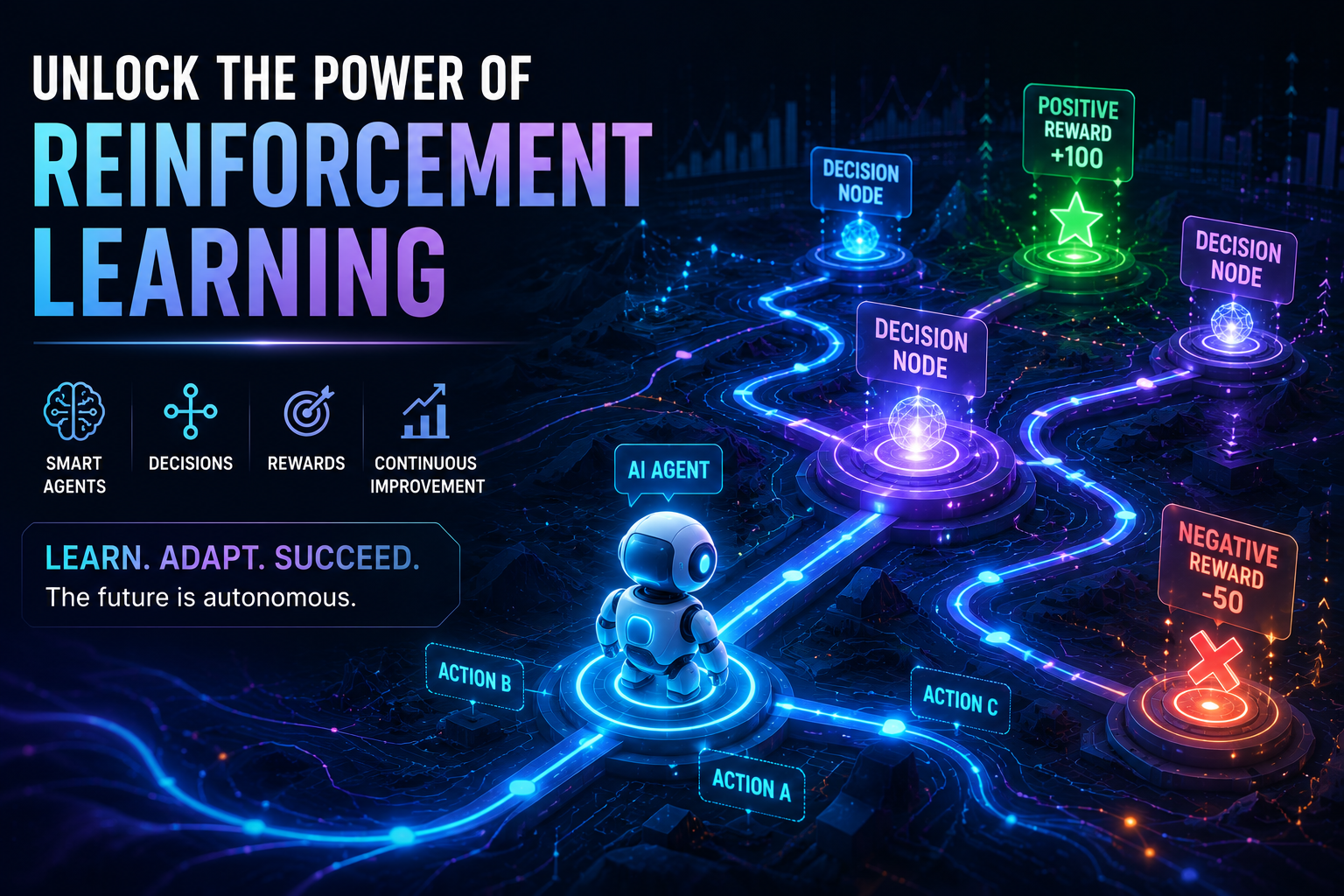
Imagine teaching a robot to walk, a video game AI to play like a champion, or a recommendation system to perfectly predict your next favorite song. These aren’t feats of magic; they are the incredible results of a powerful machine learning paradigm called Reinforcement Learning (RL). If you’ve ever wondered how artificial intelligence learns through trial and error, you’ve come to the right place. This guide will demystify Reinforcement Learning, breaking down its core concepts, key components, and diverse applications in a way that’s accessible to everyone, even if you’re new to the world of AI.
What is Reinforcement Learning?
At its heart, Reinforcement Learning is a type of machine learning where an agent learns to make a sequence of decisions in an environment to achieve a specific goal. Unlike supervised learning, where an AI is trained on labeled data (input-output pairs), or unsupervised learning, where it finds patterns in unlabeled data, RL operates on a system of rewards and punishments. The agent learns by interacting with its environment, taking actions, and observing the consequences of those actions. The ultimate aim is to maximize its cumulative reward over time.
Think of teaching a dog a new trick. You give a command (the agent’s action), the dog performs something (the environment’s state change), and if it does well, you give it a treat (a reward). If it doesn’t, it gets no treat or perhaps a gentle correction (a punishment or lack of reward). Over time, the dog learns which actions lead to treats and starts performing them more frequently. Reinforcement Learning works on a similar principle, but with algorithms and sophisticated mathematical frameworks.
The Core Components of Reinforcement Learning
To truly grasp RL, it’s essential to understand its fundamental building blocks:
- Agent: This is the learner or decision-maker. It’s the AI program that interacts with the environment and aims to achieve a goal.
- Environment: This is the external system with which the agent interacts. It’s the world where the agent operates and takes actions.
- State (s): A state represents the current situation or configuration of the environment. It’s the information the agent receives from the environment.
- Action (a): An action is a move or decision that the agent can make in a given state. The set of possible actions depends on the environment and the agent’s capabilities.
- Reward (r): A reward is a scalar feedback signal from the environment that indicates how good or bad an action was in a particular state. The agent’s objective is to maximize the total accumulated reward.
- Policy (π): A policy defines the agent’s behavior. It’s a mapping from states to actions, dictating what action the agent should take in any given state. The goal of RL is to learn an optimal policy.
- Value Function (V or Q): A value function estimates the expected future reward an agent can receive from a particular state (V) or from taking a specific action in a state (Q). These functions help the agent evaluate the long-term desirability of different states and actions.
How Reinforcement Learning Works: The Learning Loop
The process of Reinforcement Learning can be visualized as a continuous loop:
- The agent observes the current state (s) of the environment.
- Based on its current policy (π), the agent chooses an action (a).
- The agent performs the action in the environment.
- The environment transitions to a new state (s’) and provides a reward (r) to the agent.
- The agent uses this reward and the new state to update its policy and value functions, learning which actions are more beneficial in the long run.
- This loop repeats, allowing the agent to gradually improve its performance and discover optimal strategies.
Exploration vs. Exploitation: The RL Dilemma
A crucial aspect of Reinforcement Learning is the balance between exploration and exploitation.
- Exploration: This involves trying out new, potentially suboptimal actions to discover potentially better strategies or rewards. It’s like trying a new dish at a restaurant to see if you like it.
- Exploitation: This involves sticking with known strategies or actions that have previously yielded good rewards. It’s like ordering your favorite dish at a restaurant because you know you’ll enjoy it.
An effective RL agent needs to find the right balance. Too much exploration might lead to consistently suboptimal decisions, while too much exploitation might cause the agent to miss out on higher rewards it could discover.
Key Algorithms in Reinforcement Learning
Several algorithms have been developed to tackle the challenges of Reinforcement Learning. Here are a few prominent ones:
- Q-Learning: A model-free, off-policy algorithm that learns an action-value function (Q-function). It iteratively updates Q-values based on observed rewards and future Q-values, aiming to converge to the optimal Q-function.
- SARSA (State-Action-Reward-State-Action): Similar to Q-Learning, SARSA is also a model-free algorithm but it’s an on-policy algorithm. It learns the Q-function by considering the action that the current policy will take in the next state.
- Deep Q-Networks (DQN): A breakthrough that combines Q-Learning with deep neural networks. DQNs can handle complex, high-dimensional state spaces (like raw pixel data from video games) by using a neural network to approximate the Q-function.
- Policy Gradients: These algorithms directly learn the policy, often represented by a neural network. They adjust the policy parameters to increase the probability of actions that lead to higher rewards.
- Actor-Critic Methods: These methods combine elements of both value-based (like Q-learning) and policy-based (like policy gradients) methods. The “actor” learns the policy, while the “critic” learns the value function to guide the actor’s learning.
Applications of Reinforcement Learning
Reinforcement Learning is not just a theoretical concept; it’s powering real-world innovations across various domains:
- Robotics: Teaching robots to perform complex tasks like grasping objects, walking, and navigating in unknown environments.
- Game Playing: AI agents that can play complex games like Go (AlphaGo), chess, and video games at superhuman levels.
- Autonomous Driving: Developing self-driving car systems that can make decisions in dynamic traffic situations.
- Recommendation Systems: Personalizing content recommendations for users on platforms like Netflix, YouTube, and Spotify by learning user preferences.
- Resource Management: Optimizing energy consumption in data centers, managing traffic flow in smart cities, and optimizing financial trading strategies.
- Healthcare: Developing personalized treatment plans, optimizing drug discovery, and controlling robotic surgery systems.
Challenges in Reinforcement Learning
Despite its successes, Reinforcement Learning faces several challenges:
- Sample Efficiency: RL often requires a vast amount of data and interactions with the environment, which can be time-consuming and expensive in real-world scenarios.
- Reward Engineering: Designing appropriate reward functions that effectively guide the agent towards the desired behavior can be tricky and crucial for success.
- Stability and Convergence: Ensuring that the learning process is stable and that the agent converges to an optimal or near-optimal policy can be challenging, especially with complex environments.
- Generalization: Training an agent that can perform well in unseen situations or slightly modified environments remains an active area of research.
The Future of Reinforcement Learning
Reinforcement Learning is a rapidly evolving field with immense potential. As algorithms become more sophisticated and computational power increases, we can expect RL to play an even more significant role in shaping the future of AI. From creating more intelligent virtual assistants to solving complex scientific problems, the possibilities are virtually limitless.
Conclusion
Reinforcement Learning offers a powerful framework for teaching AI systems to learn through experience, much like humans and animals do. By understanding its core components, the learning loop, and the fundamental algorithms, you’ve taken a significant step towards appreciating this transformative technology. While challenges remain, ongoing research and development promise to unlock even greater capabilities, pushing the boundaries of what artificial intelligence can achieve.
Frequently Asked Questions (FAQ)
What is the main difference between Reinforcement Learning and Supervised Learning?In supervised learning, the AI learns from labeled data (input-output pairs) and aims to predict outputs for new inputs. In reinforcement learning, the AI learns through trial and error by interacting with an environment and receiving rewards or punishments, aiming to maximize cumulative reward.Can Reinforcement Learning be used for tasks that don’t have clear goals?While RL is most effective with clearly defined goals, researchers are exploring methods for open-ended learning and intrinsic motivation, which can enable agents to explore and learn without explicit external rewards.Is Reinforcement Learning always about robots?No, Reinforcement Learning is a broad concept applicable to any sequential decision-making problem. While robotics is a prominent application, it’s also used in software agents, simulations, and data analysis.How do I get started learning Reinforcement Learning?Start with understanding the core concepts, then explore fundamental algorithms like Q-Learning. Online courses, tutorials, and libraries like OpenAI Gym and Stable Baselines3 are excellent resources.