
Did you know that not all AI is the same? The AI that recommends your next Netflix show is completely different from the AI that beats world champions at chess — and both are very different from the AI scientists dream about for the future.
Understanding the types of Artificial Intelligence helps you see the full picture of where technology stands today and where it’s heading. In this beginner-friendly guide, we’ll break it all down — simply, clearly, and with real-life examples. 🚀
🗂️ How Is AI Classified?
AI is classified in two main ways:
- By Capability — How powerful and human-like is the AI?
- By Functionality — What kind of tasks can the AI perform?
Think of it like classifying animals — you can group them by size (small, medium, large) or by diet (herbivore, carnivore, omnivore). Both ways are correct, they just describe different things.
🏆 Classification 1: By Capability (How Smart Is the AI?)
This is the most popular way to categorize AI. There are 3 main levels:
1️⃣ Narrow AI (Weak AI) — The AI We Have Today
Narrow AI is designed to perform one specific task and do it extremely well. It cannot go beyond its programming or think on its own. It’s “narrow” because its intelligence is limited to a single domain.
Simple Definition: AI that is very good at ONE thing but knows nothing outside of it.
Real-Life Examples:
- 🎵 Spotify recommending songs you’ll love
- 📧 Gmail filtering your spam automatically
- 🗣️ Siri / Alexa answering voice commands
- 🚗 Tesla Autopilot self-driving on highways
- ♟️ DeepMind’s AlphaGo beating Go champions
- 🤖 ChatGPT having text conversations
Key Point: Siri can answer your questions, but it can’t drive your car. AlphaGo can play Go, but it can’t play chess. That’s the “narrowness” — it’s brilliant at one thing, helpless at everything else.
✅ Status: EXISTS TODAY — All AI you use right now is Narrow AI.
2️⃣ General AI (Strong AI / AGI) — The AI of the Future
Artificial General Intelligence (AGI) refers to AI that can perform any intellectual task that a human can. It can learn, reason, adapt, and apply knowledge across different domains — just like a person can.
Simple Definition: AI that thinks, learns, and adapts like a human — across ALL subjects.
What AGI Would Look Like:
- 🧠 Learn a new language in hours and also fix your car
- 📚 Read a medical textbook and diagnose a patient
- 🎭 Write a screenplay AND compose the music for it
- 💡 Switch between tasks just like humans do
Real-Life Examples: None yet! AGI exists only in movies like Jarvis from Iron Man or HAL 9000 from 2001: A Space Odyssey.
⚠️ Status: DOES NOT EXIST YET — Scientists are actively working toward it, but we’re not there yet.
3️⃣ Super AI (Superintelligence) — Beyond Human Intelligence
Artificial Superintelligence (ASI) is a hypothetical AI that surpasses human intelligence in every possible way — creativity, problem-solving, emotional understanding, and wisdom. It would be to humans what humans are to ants.
Simple Definition: AI so intelligent it makes the smartest human look like a beginner.
What ASI Could Do (Theoretically):
- 🔬 Cure all diseases in days
- 🌍 Solve climate change overnight
- 🚀 Design technologies beyond our imagination
- 🧬 Understand the universe better than all scientists combined
Real-Life Examples: None — this is purely theoretical and deeply debated by scientists and philosophers.
🔮 Status: THEORETICAL ONLY — May or may not ever exist. Subject of major ethical debate.
🔧 Classification 2: By Functionality (What Can AI Do?)
This approach, proposed by Arend Hintze of Michigan State University, divides AI into 4 types based on how they function and remember:
Type 1 — Reactive Machines
The most basic type of AI. Reactive machines only react to the current situation. They have no memory, cannot learn from past experiences, and cannot plan for the future.
Simple Definition: AI that reacts to “right now” — no past, no future, just the present moment.
Examples:
- ♟️ IBM’s Deep Blue — the chess computer that beat Garry Kasparov in 1997. It analyzed the current chess board but remembered nothing about past games.
- 🎮 Basic video game bots that react to your moves
- 📧 Simple spam filters that check the current email
Type 2 — Limited Memory AI
This AI can use past experiences (memory) to make better decisions, but only for a short period. It learns from recent data and applies it to current decisions.
Simple Definition: AI that remembers recent events to make smarter choices — like short-term memory.
Examples:
- 🚗 Self-driving cars — they remember road data, speed of nearby vehicles, and lane positions from the last few seconds to drive safely
- 💬 ChatGPT — remembers your earlier messages within the same conversation
- 📺 Netflix recommendations — learns from your recent watch history
- 🗣️ Voice assistants — follow the context of recent conversation turns
✅ This is the most common type of AI in use today.
Type 3 — Theory of Mind AI
This is a more advanced type of AI that can understand human emotions, beliefs, and intentions. It would be aware that humans have thoughts and feelings that affect their behavior.
Simple Definition: AI that understands what you think and feel — like a truly empathetic companion.
Examples:
- 🤖 Sophia the Robot (by Hanson Robotics) — shows early attempts at reading emotions
- 🧠 Advanced social robots being developed in research labs
- 💊 Experimental AI therapists and companions
⚠️ Status: IN DEVELOPMENT — Early research exists, but true Theory of Mind AI is not here yet.
Type 4 — Self-Aware AI
The most advanced and currently fictional type. Self-aware AI has its own consciousness, emotions, and sense of self. It would know it exists, have its own desires, and understand its own mental states.
Simple Definition: AI that is truly conscious — it knows it’s an AI and has its own inner world.
Examples:
- 🎬 Samantha from the movie Her
- 🤖 Data from Star Trek
- 🦾 Terminator’s Skynet — aware and self-preserving
🔮 Status: DOES NOT EXIST — Purely theoretical and the subject of major philosophical debate.
🔍 Key Differences: All Types at a Glance
| Type | Category | Memory | Emotions | Exists? |
|---|---|---|---|---|
| Narrow AI | By Capability | Limited | ❌ No | ✅ Yes |
| General AI (AGI) | By Capability | Full | Possibly | ❌ Not yet |
| Super AI (ASI) | By Capability | Beyond Human | Unknown | ❌ Theoretical |
| Reactive Machine | By Functionality | ❌ None | ❌ No | ✅ Yes |
| Limited Memory | By Functionality | ✅ Short-term | ❌ No | ✅ Yes |
| Theory of Mind | By Functionality | ✅ Yes | ⚠️ Developing | ⚠️ Partial |
| Self-Aware AI | By Functionality | ✅ Full | ✅ Yes | ❌ Theoretical |
🔗 How Are All These Types Related?
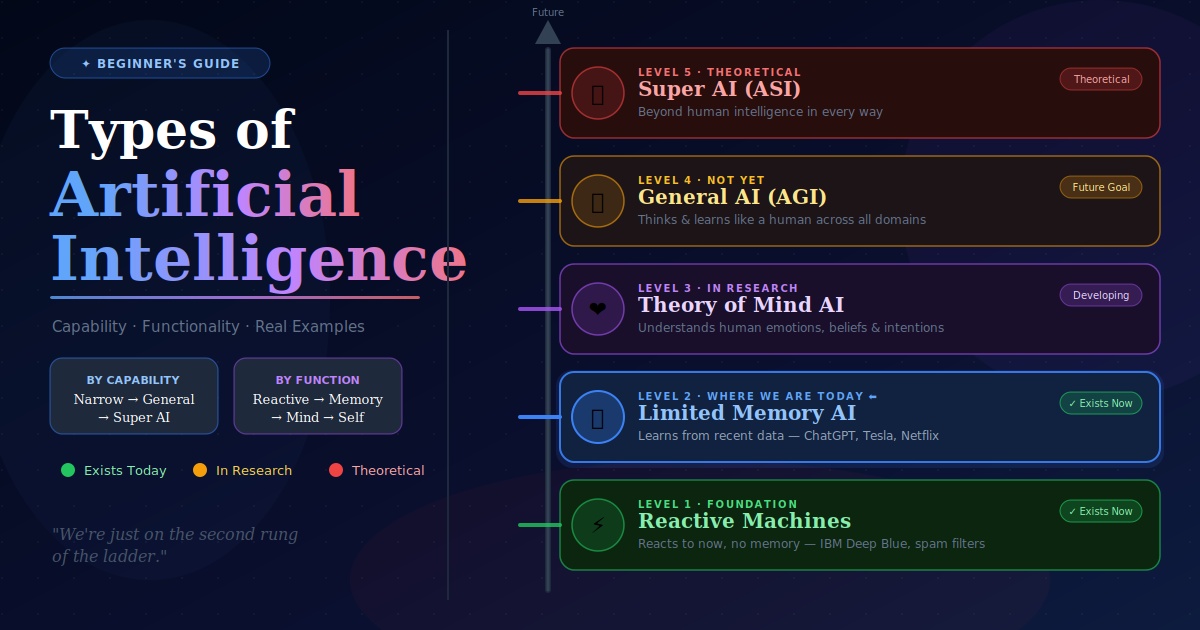
Think of it as a ladder of intelligence:
- 🪜 Bottom rung: Reactive Machines — no memory, just reactions
- 🪜 Second rung: Limited Memory — learns from recent data (where we are today)
- 🪜 Third rung: Theory of Mind — understands human emotions (under research)
- 🪜 Fourth rung: Self-Aware AI — conscious machines (theoretical)
- 🪜 Top rung: Superintelligence — beyond all human comprehension
Today’s AI (like ChatGPT, Alexa, Siri, Tesla) sits on the first and second rungs. We haven’t climbed higher yet — but the race is on.
💡 Quick Analogy to Remember
Imagine teaching a dog different tricks:
- A Reactive AI is like a dog that only sits when you say “sit” — no memory, just reaction
- A Limited Memory AI is like a dog that remembers its recent training and gets better over time
- A Theory of Mind AI is like a dog that senses your mood and comforts you when you’re sad
- A Self-Aware AI would be a dog that knows it’s a dog, questions its existence, and decides what it wants to do
✅ Summary
- ✔️ AI is classified by Capability (Narrow → General → Super) and Functionality (Reactive → Limited Memory → Theory of Mind → Self-Aware)
- ✔️ Narrow AI is the only type that exists today — and it’s already changing the world
- ✔️ AGI is the next big goal — machines that think like humans across all domains
- ✔️ Superintelligence is a distant, theoretical dream (or fear) for the future
- ✔️ Most AI tools you use daily are Limited Memory AI — learning from recent data to serve you better
Now you know more about AI than most people! Understanding these types helps you see the real potential — and limitations — of today’s technology. We’re just getting started.
Which type of AI do you think will impact your life the most? Share your thoughts in the comments! 💬

Recent Comments