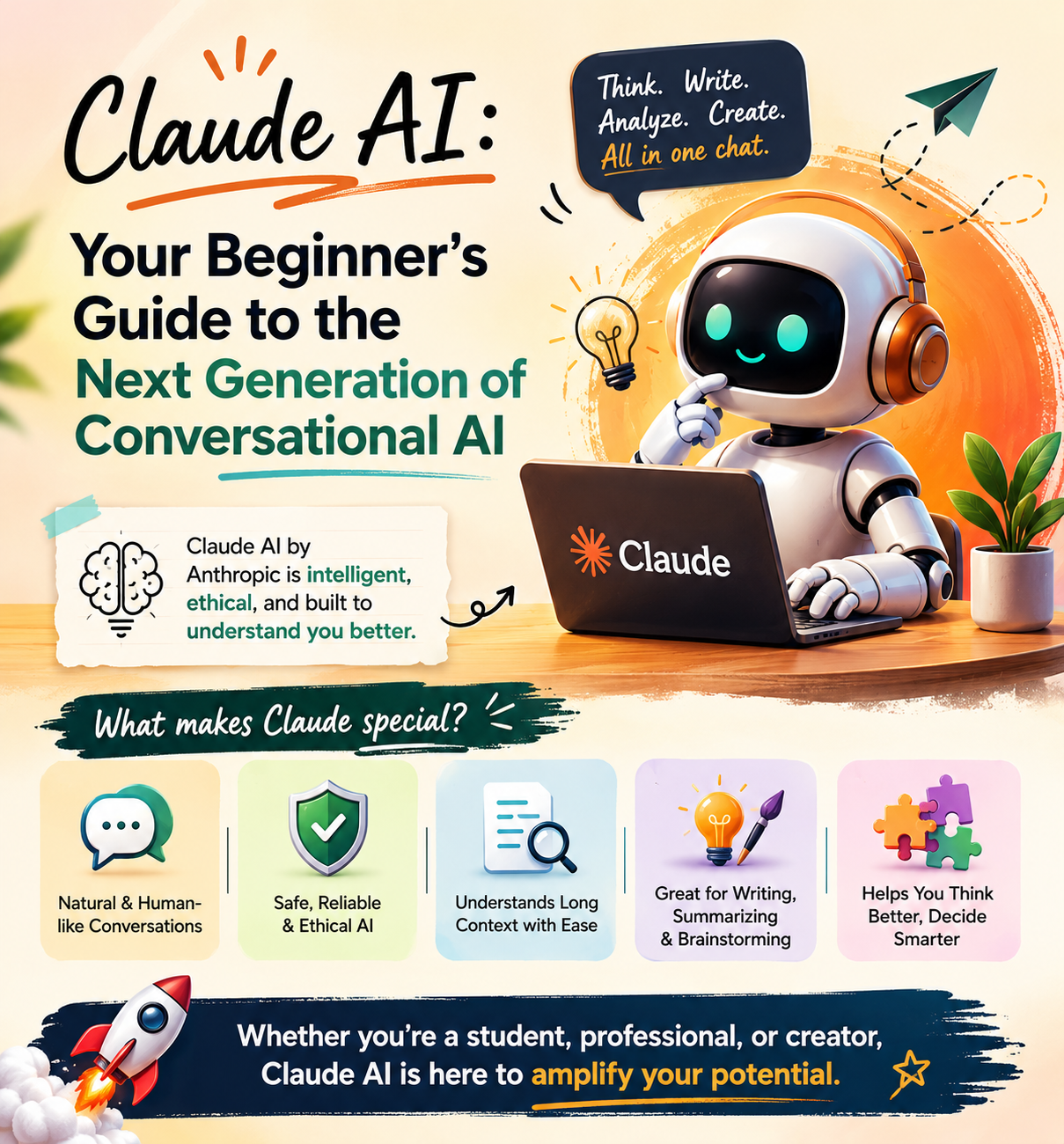
In the rapidly evolving landscape of artificial intelligence, new tools and technologies emerge with astonishing speed. Among the most exciting developments is Claude AI, a sophisticated conversational AI model that promises to redefine how we interact with machines. Developed by Anthropic, a leading AI safety and research company, Claude is designed to be more than just a chatbot; it’s an intelligent assistant built on a foundation of ethical principles and a deep understanding of human language. Whether you’re a curious individual, a business owner, or a tech enthusiast, understanding Claude AI is crucial for staying ahead in the digital age. This comprehensive guide will demystify Claude, explaining what it is, how it works, its key features, and its transformative potential.
What is Claude AI?
At its core, Claude AI is a large language model (LLM) designed to engage in natural, coherent, and helpful conversations. Unlike some AI models that prioritize raw computational power or complex algorithms, Claude is explicitly engineered with an emphasis on safety, ethics, and helpfulness. Anthropic’s guiding principle for Claude is to create AI that is helpful, honest, and harmless (often referred to as the “HHH” principle). This means that Claude is trained to avoid generating biased, toxic, or misleading information, striving instead to provide accurate, safe, and beneficial responses.
Think of Claude as a highly intelligent and well-behaved digital assistant. It can understand complex prompts, generate creative text formats, answer your questions in an informative way, and even assist with tasks like writing, coding, and summarizing information. Its ability to maintain context over longer conversations makes it particularly adept at handling nuanced discussions and complex queries.
How Does Claude AI Work?
The inner workings of Claude AI, like other advanced LLMs, involve sophisticated machine learning techniques, primarily based on deep learning and neural networks. Here’s a simplified breakdown:
- Training Data: Claude is trained on a massive dataset of text and code. This data includes books, articles, websites, and other forms of written information. The sheer volume of this data allows Claude to learn patterns, grammar, facts, reasoning abilities, and different writing styles.
- Transformer Architecture: Claude utilizes a transformer architecture, a revolutionary neural network design that excels at processing sequential data like text. This architecture allows Claude to weigh the importance of different words in a sentence and understand the relationships between them, leading to more coherent and contextually relevant responses.
- Reinforcement Learning from Human Feedback (RLHF): A crucial aspect of Claude’s development is RLHF. This process involves humans providing feedback on Claude’s responses. The AI learns from this feedback, being rewarded for helpful, honest, and harmless outputs, and penalized for undesirable ones. This iterative process is key to aligning Claude’s behavior with human values and ethical guidelines.
- Constitutional AI: Anthropic has pioneered a technique called Constitutional AI. Instead of relying solely on human feedback for every situation, Claude is trained to follow a set of guiding principles (a “constitution”). This constitution helps Claude self-critique and revise its responses to ensure they align with desired ethical standards, making the training process more scalable and robust.
This combination of vast data, advanced architecture, and ethical training methods enables Claude to perform a wide range of tasks with impressive accuracy and safety.
Key Features and Capabilities of Claude AI
Claude AI boasts a suite of features that make it a versatile tool for various applications. Its capabilities are continuously being refined, but here are some of its standout features:
- Natural Language Understanding and Generation: Claude excels at understanding human language, even when it’s complex or nuanced. It can then generate human-like text that is coherent, grammatically correct, and contextually appropriate.
- Contextual Awareness: Claude can maintain context over extended conversations, remembering previous turns and using that information to inform its current responses. This is vital for engaging in meaningful dialogue and complex problem-solving.
- Summarization: Claude can quickly digest large amounts of text and provide concise, accurate summaries. This is invaluable for research, content creation, and information processing.
- Content Creation: From drafting emails and blog posts to writing creative stories and poems, Claude can assist in generating various forms of written content.
- Coding Assistance: Claude can understand and generate code in multiple programming languages, debug existing code, and explain complex programming concepts.
- Question Answering: Claude can access and process information to answer a wide range of questions, providing detailed and informative responses.
- Creative Writing: Experiment with different creative writing prompts. Claude can help brainstorm ideas, develop characters, and even write entire narrative pieces.
- Safety and Ethical Guardrails: As mentioned, Claude is built with safety at its core. It’s designed to refuse harmful requests and to avoid generating biased or inappropriate content, making it a more trustworthy AI companion.
Practical Applications of Claude AI
The potential applications of Claude AI are vast and continue to expand across various industries and personal uses. Here are a few prominent examples:
- Customer Service: Claude can power intelligent chatbots that provide instant, accurate, and helpful customer support, improving user experience and reducing operational costs.
- Content Marketing: Businesses can leverage Claude to generate blog post ideas, draft articles, write social media copy, and create marketing emails, significantly streamlining content creation workflows.
- Education: Claude can serve as a personalized tutor, explaining complex subjects, answering student questions, and providing feedback on assignments, making learning more accessible and engaging.
- Software Development: Developers can use Claude for code generation, debugging assistance, documentation writing, and understanding new programming languages, boosting productivity.
- Research and Analysis: Researchers can use Claude to summarize lengthy documents, extract key information from research papers, and identify trends in large datasets, accelerating the research process.
- Personal Productivity: Individuals can use Claude for drafting emails, planning schedules, brainstorming ideas, learning new skills, or simply as a conversational partner for creative exploration.
- Accessibility: Claude’s ability to process and generate text can aid individuals with disabilities, for instance, by transcribing audio content or generating alternative text descriptions for images.
Claude AI vs. Other AI Models
While the field of AI is crowded with powerful models, Claude AI distinguishes itself through its unique focus on safety and ethical alignment. Many AI models are trained to maximize performance on specific tasks, sometimes at the expense of ethical considerations. Anthropic’s commitment to the “HHH” principle means Claude is designed to be inherently more trustworthy and less prone to generating harmful or biased outputs. This makes it an excellent choice for applications where reliability and ethical integrity are paramount.
Furthermore, Claude’s advanced reasoning capabilities and its ability to handle long contexts often give it an edge in complex, multi-turn conversations and detailed analytical tasks compared to models with more limited contextual windows.
Getting Started with Claude AI
Accessing and using Claude AI is becoming increasingly straightforward. Anthropic offers access through various channels, including:
- Web Interface: Users can interact with Claude directly through a user-friendly web interface, making it accessible to anyone with an internet connection.
- API Access: Developers can integrate Claude into their own applications and services through Anthropic’s API, unlocking its potential for custom solutions.
- Partnerships: Claude is being integrated into various platforms and services, meaning you might already be interacting with it without realizing it!
Keep an eye on Anthropic’s official website and announcements for the latest information on how to access and utilize Claude. As the technology matures, more user-friendly options and specialized versions are likely to emerge.
The Future of Claude AI
The development of AI is a continuous journey, and Claude AI is at the forefront of this progress. Future iterations are expected to feature even more advanced reasoning, greater contextual understanding, and expanded capabilities in areas like multimodal understanding (processing images and audio alongside text). Anthropic’s unwavering commitment to AI safety and ethics suggests that Claude will continue to be a benchmark for responsible AI development.
As Claude evolves, it will undoubtedly play an increasingly significant role in shaping how we work, learn, and interact with technology. Its potential to augment human capabilities and solve complex problems responsibly is immense.
Conclusion
Claude AI represents a significant leap forward in conversational AI. By prioritizing helpfulness, honesty, and harmlessness, Anthropic has created a powerful yet ethical AI assistant that can empower individuals and businesses alike. From streamlining workflows and enhancing creativity to fostering safer online interactions, Claude’s potential is undeniable. As you explore the world of AI, understanding Claude is an essential step towards harnessing the benefits of this transformative technology. Its user-friendly interface, robust capabilities, and strong ethical foundation make it a compelling choice for anyone looking to leverage the power of advanced AI.
Frequently Asked Questions about Claude AI
What makes Claude AI different from other chatbots?
Claude AI’s primary differentiator is its core design principle of being helpful, honest, and harmless (HHH). This means it’s specifically trained to avoid generating biased, toxic, or misleading information, making it more ethically aligned and trustworthy than many other AI models.
Is Claude AI free to use?
Access to Claude AI can vary. Anthropic offers different tiers of access, including free trial periods or limited free usage, as well as paid plans for more extensive use or API access. Check the official Anthropic website for the most current pricing and access information.
Can Claude AI access real-time information from the internet?
While Claude is trained on a vast dataset, its knowledge is based on the data it was trained on up to a certain point. It does not have live access to the internet to browse current events in real-time unless specifically integrated with tools that provide such capabilities.
What are the potential limitations of Claude AI?
Like all AI models, Claude has limitations. It can sometimes generate incorrect information (hallucinate), its understanding of extremely niche or rapidly evolving topics might be limited by its training data, and it may not always grasp subtle nuances or implied meanings in human communication perfectly.
How is Claude AI being used in businesses?
Businesses are using Claude AI for customer support automation, content creation, marketing copy generation, internal knowledge base assistance, code generation and review, and data summarization. Its safety features make it suitable for public-facing applications.
Recent Comments