
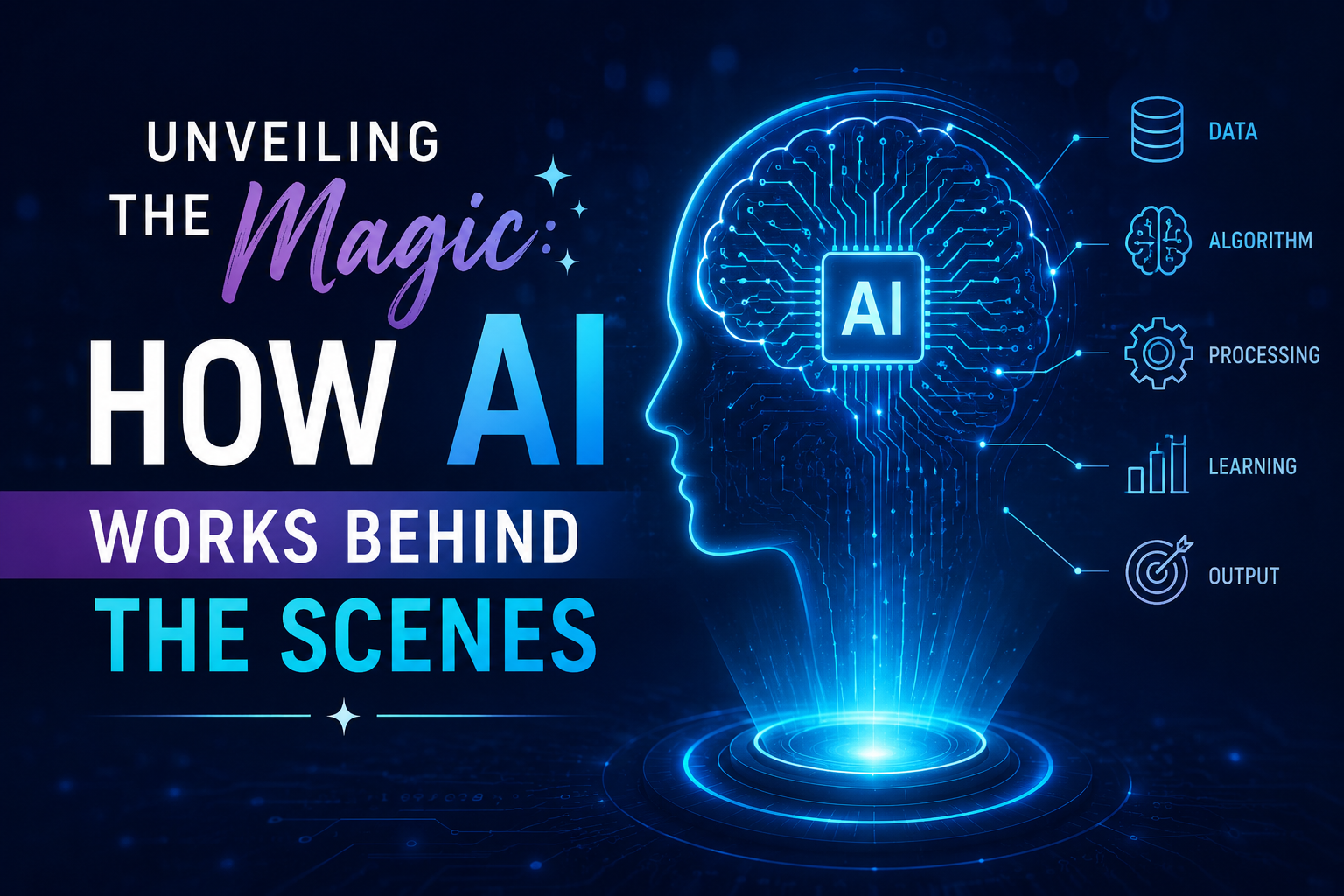
Artificial Intelligence (AI) is no longer a concept confined to science fiction. It powers our smartphones, recommends our next binge-watch, drives our cars (sometimes!), and is rapidly transforming industries. But have you ever stopped to wonder, “How does it actually work?” Beyond the buzzwords and futuristic visions, there’s a fascinating world of algorithms, data, and intricate processes that bring AI to life. This blog post is your beginner-friendly guide to understanding the magic happening behind the scenes.
What Exactly is Artificial Intelligence?
Before we dive into the “how,” let’s clarify the “what.” At its core, Artificial Intelligence refers to the simulation of human intelligence in machines that are programmed to think and learn like humans. This doesn’t mean creating conscious robots (at least, not yet!). Instead, AI focuses on enabling machines to perform tasks that typically require human intelligence, such as:
- Learning
- Problem-solving
- Decision-making
- Perception
- Understanding natural language
Think of AI as a broad umbrella term that encompasses various approaches and technologies. Two of the most prominent subfields are Machine Learning (ML) and Deep Learning (DL).
Machine Learning: The Engine of AI’s Learning
Machine Learning is arguably the most crucial component of modern AI. Instead of explicitly programming a machine to perform every possible scenario, ML allows computers to learn from data without being explicitly programmed. It’s like teaching a child by showing them examples, rather than giving them a rigid set of rules for every situation.
The Core Idea: Learning from Data
The fundamental principle of ML is that algorithms can identify patterns and make predictions or decisions based on the data they are fed. The more data an ML model processes, the better it becomes at its task.
Types of Machine Learning
There are three primary types of Machine Learning:
- Supervised Learning: This is the most common type. In supervised learning, the algorithm is trained on a labeled dataset. This means each data point has a corresponding correct output. Think of it as learning with a teacher. For example, to train an AI to recognize cats, you’d show it thousands of images labeled “cat” and “not cat.” The algorithm learns the features associated with cats (ears, whiskers, fur texture) and can then identify cats in new, unseen images. Common applications include image recognition, spam detection, and predicting house prices.
- Unsupervised Learning: Here, the algorithm is given unlabeled data and must find patterns and structures on its own. There’s no “right answer” provided during training. This is like learning by exploration. The algorithm might group similar data points together (clustering) or reduce the complexity of the data (dimensionality reduction). Examples include customer segmentation for marketing, anomaly detection (identifying unusual behavior), and topic modeling.
- Reinforcement Learning: This type of learning involves an agent interacting with an environment. The agent learns through trial and error, receiving rewards for desirable actions and penalties for undesirable ones. The goal is to maximize cumulative reward over time. This is akin to learning by doing and getting feedback. It’s famously used in training AI to play games (like AlphaGo), robotics, and optimizing complex systems.
How Machine Learning Algorithms Work (Simplified)
While the specifics can get complex, the general workflow for many ML algorithms involves:
- Data Collection: Gathering a large and relevant dataset.
- Data Preprocessing: Cleaning, organizing, and transforming the data into a format suitable for the algorithm. This might involve handling missing values, removing duplicates, or scaling features.
- Model Selection: Choosing an appropriate ML algorithm for the task (e.g., a linear regression for prediction, a support vector machine for classification).
- Model Training: Feeding the preprocessed data to the chosen algorithm. The algorithm adjusts its internal parameters to minimize errors and identify patterns.
- Model Evaluation: Testing the trained model on a separate set of data (not used during training) to assess its performance and accuracy.
- Hyperparameter Tuning: Fine-tuning the model’s settings (hyperparameters) to further improve performance.
- Deployment: Using the trained model to make predictions or decisions on new, real-world data.
Deep Learning: The Power of Neural Networks
Deep Learning (DL) is a subfield of Machine Learning that is inspired by the structure and function of the human brain’s neural networks. DL models, known as artificial neural networks, are particularly adept at handling complex patterns and unstructured data like images, audio, and text.
Artificial Neural Networks: Mimicking the Brain
Imagine a network of interconnected “neurons” (mathematical functions) organized in layers. These layers include:
- Input Layer: Receives the raw data.
- Hidden Layers: These are the core of the network where complex computations and feature extraction occur. Deep learning models have multiple hidden layers, hence the “deep” in their name. Each layer processes the information from the previous one, learning increasingly abstract representations of the data.
- Output Layer: Produces the final result or prediction.
Each connection between neurons has a “weight,” which determines the strength of the signal. During training, these weights are adjusted to ensure the network learns to produce the correct output for a given input. This adjustment process is similar to how neurons in our brain strengthen or weaken connections based on experience.
How Deep Learning Models Learn
The learning process in Deep Learning involves:
- Forward Propagation: Input data is fed through the network, and a prediction is made.
- Loss Calculation: The difference between the predicted output and the actual correct output is calculated (this is the “error” or “loss”).
- Backpropagation: This is the crucial step where the error is propagated backward through the network. The algorithm uses this error information to adjust the weights of the connections, aiming to reduce the error in future predictions.
- Gradient Descent: A mathematical optimization algorithm used during backpropagation to find the set of weights that minimizes the loss function.
This iterative process of forward propagation, loss calculation, and backpropagation, repeated thousands or millions of times with vast amounts of data, allows deep learning models to achieve remarkable accuracy in tasks like:
- Image and video recognition (e.g., identifying objects, facial recognition)
- Natural Language Processing (NLP) (e.g., translation, sentiment analysis, chatbots)
- Speech recognition
- Autonomous driving
- Medical diagnosis
Key Concepts in AI Development
Understanding how AI works also involves grasping a few fundamental concepts:
Algorithms
At the heart of AI are algorithms. These are sets of rules or instructions that a computer follows to perform a specific task or solve a problem. Different AI tasks require different types of algorithms, from simple linear regression to complex convolutional neural networks.
Data
Data is the lifeblood of AI. Without sufficient, high-quality data, AI models cannot learn effectively. The type and quantity of data are critical. For instance, an AI designed to detect cancerous cells will require vast datasets of medical images. Similarly, a language model needs an enormous corpus of text to understand grammar, context, and meaning.
Features
Features are the individual, measurable properties or characteristics of the data that the AI uses to learn. For example, in an image of a cat, features might include the shape of its ears, the presence of whiskers, or the color of its fur. In a dataset of house prices, features could be square footage, number of bedrooms, and location.
Training and Testing Sets
To ensure an AI model is not just memorizing the data it was trained on (overfitting), it’s crucial to split the data into two main sets:
- Training Set: Used to teach the AI model.
- Testing Set: Used to evaluate the model’s performance on unseen data. This gives a realistic measure of how well the AI will perform in the real world.
Models
Once an algorithm is trained on data, it becomes a “model.” This model encapsulates the learned patterns and relationships, ready to make predictions or decisions on new data.
Putting it All Together: A Real-World Example
Let’s say you’re using a streaming service, and its AI recommends a new show you end up loving. How did it do that?
- Data Collection: The service collects data on your viewing history, what you’ve liked, what you’ve skipped, shows you’ve rated, and perhaps even the genres you tend to watch. It also collects data on millions of other users’ preferences and viewing habits.
- Machine Learning Algorithm: A recommendation engine, likely using collaborative filtering or content-based filtering (or a combination), is employed. This algorithm is a type of ML model.
- Training: The algorithm is trained on this massive dataset to identify patterns. It learns which shows are often watched together, what characteristics of shows are associated with user satisfaction, and how your preferences align with others.
- Feature Extraction: The AI might analyze features of shows like genre, actors, directors, plot keywords, and even user-generated tags. For your personal viewing habits, features are your watched shows, ratings, and genre preferences.
- Prediction: Based on the learned patterns, the AI predicts shows you’re likely to enjoy, taking into account your past behavior and the behavior of similar users.
- Recommendation: The recommended show is presented to you. If you watch and enjoy it, this positive feedback further refines the model for future recommendations.
The Future of AI
The field of AI is evolving at an astonishing pace. We’re seeing advancements in areas like:
- Generative AI: Models that can create new content, such as text, images, music, and code (like the one generating this blog post!).
- Explainable AI (XAI): Efforts to make AI decisions more transparent and understandable.
- Edge AI: Deploying AI models directly on devices rather than relying solely on the cloud, enabling faster processing and improved privacy.
Understanding the foundational principles of how AI works is becoming increasingly important as these technologies become more integrated into our daily lives.
Conclusion
The magic of Artificial Intelligence isn’t truly magic; it’s a sophisticated interplay of algorithms, vast amounts of data, and powerful computing. From the foundational concepts of Machine Learning to the intricate workings of Deep Learning’s neural networks, AI systems are designed to learn, adapt, and perform tasks that were once the sole domain of human intellect. By demystifying these processes, we gain a clearer appreciation for the technology shaping our present and future, and we can better navigate the exciting possibilities it unlocks.
Frequently Asked Questions (FAQ)
What’s the difference between AI, Machine Learning, and Deep Learning?
Think of AI as the overarching concept of creating intelligent machines. Machine Learning is a subset of AI that enables systems to learn from data without explicit programming. Deep Learning is a further subset of Machine Learning that uses multi-layered neural networks inspired by the human brain.
Do AI systems have consciousness?
Currently, no. AI systems are sophisticated tools that can perform complex tasks. They do not possess consciousness, emotions, or self-awareness in the way humans do.
How much data is needed to train an AI?
The amount of data required varies greatly depending on the complexity of the task and the type of AI model. For simple tasks, a few thousand data points might suffice. For complex tasks like image recognition or natural language processing, millions or even billions of data points are often necessary.
Is AI dangerous?
Like any powerful technology, AI has potential risks and ethical considerations. These include issues of bias in data, job displacement, privacy concerns, and the potential for misuse. Responsible development and deployment are crucial to mitigate these risks.
Can AI be biased?
Yes, AI systems can inherit biases present in the data they are trained on. If the training data is not representative or contains societal biases, the AI model will likely reflect those biases in its outputs. This is a significant area of research and development in AI ethics.
Recent Comments