
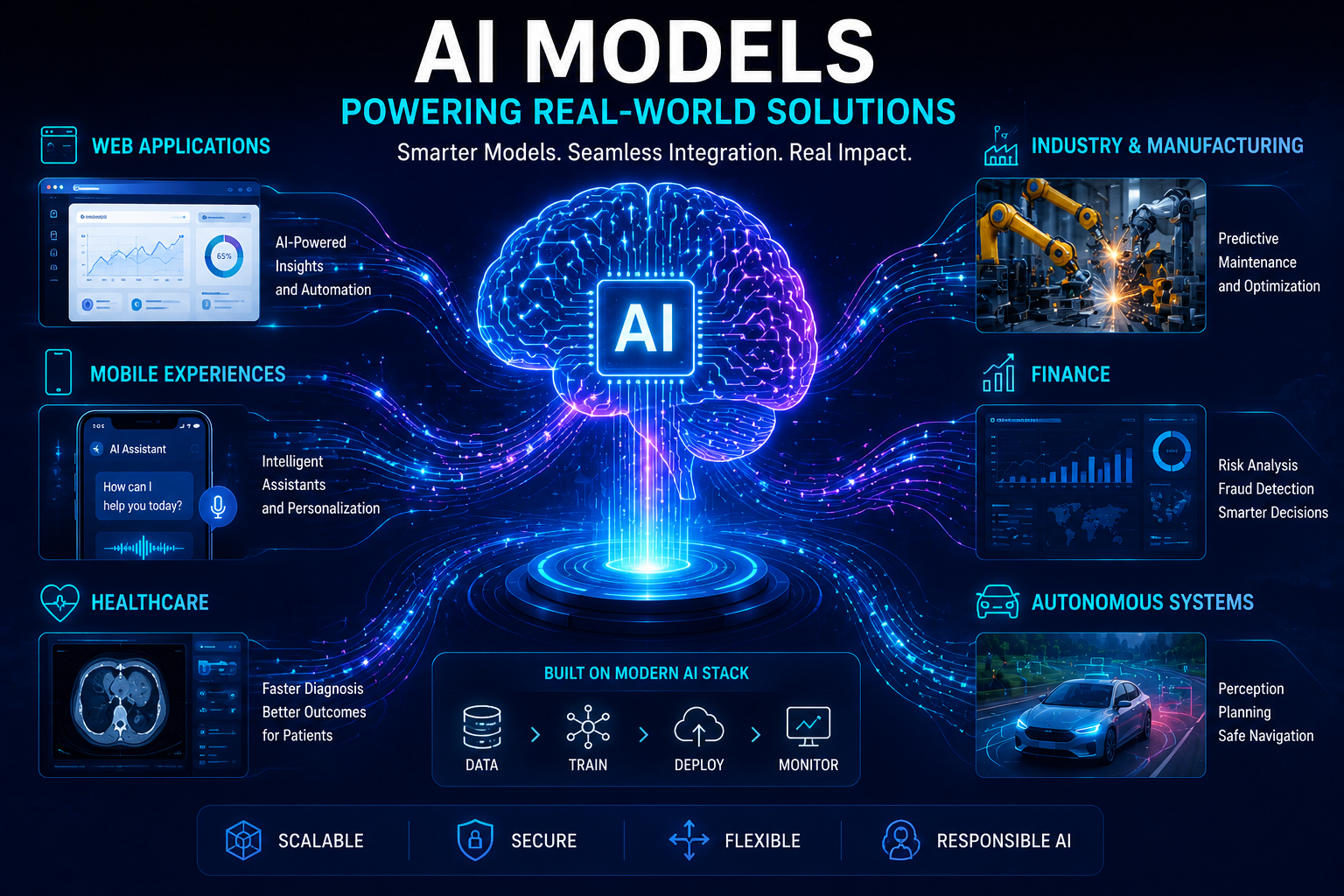
Demystifying AI Model Deployment – From Development to Real-World Impact
You’ve spent countless hours building, training, and fine-tuning your Artificial Intelligence (AI) model. It performs brilliantly in your lab environment, achieving impressive accuracy metrics. But the true test of your AI’s power lies not in its performance on a test set, but in its ability to solve real-world problems. This is where AI model deployment comes into play – the crucial process of taking your trained AI model and making it available for use by end-users or other systems. For many, the journey from a promising model to a production-ready solution can feel like navigating a complex maze. This guide aims to demystify AI model deployment, breaking down the key concepts, strategies, and best practices in a professional yet beginner-friendly manner.
What is AI Model Deployment?
At its core, AI model deployment is the process of making a trained machine learning or deep learning model available in a production environment. This means integrating the model into an application, service, or workflow where it can receive new, unseen data and generate predictions or decisions. Think of it as the bridge between your data science lab and the actual users or systems that will benefit from your AI’s intelligence. Without successful deployment, even the most sophisticated AI model remains a theoretical construct, incapable of delivering tangible value.
Why is AI Model Deployment So Important?
The impact of effective AI model deployment cannot be overstated. It’s the gateway to:
- Real-World Problem Solving: This is the ultimate goal of AI development. Deployment allows your model to address specific business challenges, automate tasks, provide insights, and enhance user experiences.
- Generating Business Value: Deployed AI models can lead to increased efficiency, cost savings, new revenue streams, improved customer satisfaction, and a competitive edge.
- Iterative Improvement: Once deployed, models generate data on their own performance. This feedback loop is invaluable for identifying areas of improvement, retraining models, and continuously enhancing their accuracy and relevance.
- Scalability: Successful deployment strategies ensure that your AI can handle increasing amounts of data and user requests as demand grows.
- Accessibility: Deployment makes your AI’s capabilities accessible to a wider audience, whether they are internal teams, external customers, or other software systems.
Key Stages of AI Model Deployment
While the specifics can vary, most AI model deployment processes follow a general set of stages:
1. Model Finalization and Packaging
Before deployment, your model needs to be finalized. This involves:
- Selecting the Best Model: Choosing the model that best meets your performance, efficiency, and interpretability requirements.
- Saving the Model: Serializing the trained model into a format that can be loaded and used for inference. Common formats include Pickle, HDF5, TensorFlow SavedModel, and ONNX.
- Dependencies Management: Ensuring all necessary libraries and frameworks are documented and packaged alongside the model.
- Containerization (Optional but Recommended): Packaging the model and its dependencies into a container (e.g., Docker) for consistent execution across different environments.
2. Choosing a Deployment Strategy
The choice of deployment strategy depends heavily on your application’s needs, infrastructure, and scale. Here are some common approaches:
a) Batch Prediction
In batch prediction, the AI model processes a large set of data at once, generating predictions for all data points. This is suitable for scenarios where real-time predictions are not critical, such as:
- Customer segmentation
- Report generation
- Data enrichment
Pros: Efficient for large datasets, can be scheduled to run during off-peak hours.
Cons: Not suitable for real-time applications.
b) Real-Time/Online Prediction
Real-time prediction involves the AI model making predictions on individual data points as they arrive. This is crucial for applications requiring immediate responses, such as:
- Fraud detection
- Recommendation engines
- Chatbots
- Automotive driving systems
This is typically achieved by hosting the model behind an API endpoint.
Pros: Provides immediate insights and actions.
Cons: Requires robust infrastructure and careful management of latency.
c) Edge Deployment
Edge deployment involves running the AI model directly on devices at the ‘edge’ of the network, such as smartphones, IoT devices, or on-premises servers, rather than in a centralized cloud. This is beneficial for:
- Privacy-sensitive applications
- Reducing latency
- Operating in environments with limited connectivity
Examples include smart cameras, autonomous vehicles, and industrial IoT sensors.
Pros: Low latency, enhanced privacy, reduced bandwidth usage.
Cons: Limited computational resources on edge devices, challenging to update models remotely.
3. Infrastructure and Hosting
Where will your AI model live? The options are varied:
- Cloud Platforms (AWS, Azure, GCP): Offer managed services for hosting, scaling, and serving AI models (e.g., SageMaker, Azure ML, Vertex AI). These platforms abstract away much of the infrastructure complexity.
- On-Premises Servers: You manage your own hardware and software, offering greater control but requiring significant IT resources and expertise.
- Hybrid Cloud: A combination of cloud and on-premises solutions.
- Edge Devices: As discussed above, running models directly on user devices or specialized hardware.
4. API Development (for Online Predictions)
If you’re opting for real-time predictions, you’ll likely need to expose your model through an Application Programming Interface (API). This allows other applications to send data to the model and receive predictions back. Common frameworks for building APIs include Flask, FastAPI (Python), and Node.js with Express (JavaScript).
5. Monitoring and Maintenance
Deployment is not a ‘set it and forget it’ process. Continuous monitoring and maintenance are vital for ensuring your AI model continues to perform optimally:
- Performance Monitoring: Track key metrics like accuracy, precision, recall, and inference latency.
- Data Drift Detection: Monitor changes in the distribution of incoming data compared to the training data. Data drift can significantly degrade model performance.
- Concept Drift Detection: Monitor for changes in the underlying relationship between input features and the target variable.
- Resource Utilization: Keep an eye on CPU, memory, and GPU usage to ensure efficiency and scalability.
- Model Retraining and Updates: Periodically retrain your model with fresh data and deploy updated versions to adapt to changing patterns and maintain accuracy.
Challenges in AI Model Deployment
While the benefits are clear, deployment can present challenges:
- Scalability: Ensuring the system can handle fluctuating loads.
- Latency: Meeting the response time requirements for real-time applications.
- Cost Management: Optimizing infrastructure costs, especially in the cloud.
- Security: Protecting sensitive data and the model itself.
- Version Control: Managing different versions of models and their associated code.
- Reproducibility: Ensuring that the deployed model can be reproduced and debugged effectively.
- Integration Complexity: Integrating the AI model into existing software systems and workflows.
Best Practices for Successful AI Deployment
To navigate these challenges and ensure a smooth deployment, consider these best practices:
- Start Simple: Begin with a clear understanding of the problem you’re trying to solve and the minimum viable product (MVP) for your AI solution.
- Automate Everything: Implement CI/CD (Continuous Integration/Continuous Deployment) pipelines for automated testing, building, and deployment.
- Choose the Right Tools: Select frameworks, libraries, and cloud services that align with your team’s expertise and project requirements.
- Prioritize Monitoring: Implement comprehensive monitoring solutions from the outset.
- Embrace Versioning: Use version control for both code and models.
- Document Thoroughly: Maintain clear documentation for the model, its dependencies, and the deployment process.
- Test Rigorously: Conduct extensive testing in staging environments before deploying to production.
- Plan for Rollbacks: Have a strategy in place to quickly revert to a previous stable version if issues arise.
The Future of AI Model Deployment
The field of AI model deployment is constantly evolving. We’re seeing advancements in MLOps (Machine Learning Operations), which aims to standardize and streamline the ML lifecycle, including deployment. Serverless computing, specialized AI hardware, and automated model optimization techniques are also making deployment more accessible and efficient. As AI becomes more pervasive, the ability to deploy and manage models effectively will be a critical skill for individuals and a strategic imperative for organizations.
Frequently Asked Questions (FAQ)
What is the difference between AI model training and deployment?
Training is the process of teaching an AI model by feeding it data to learn patterns and make predictions. Deployment is the process of making that trained model available for use in a real-world application.
What are the most common tools for AI model deployment?
Popular tools include cloud platforms like AWS SageMaker, Azure Machine Learning, and Google Cloud AI Platform, containerization tools like Docker, orchestration tools like Kubernetes, and API frameworks like Flask and FastAPI.
How do I monitor my deployed AI model?
Monitoring typically involves tracking model performance metrics (accuracy, latency), data drift, concept drift, and resource utilization. Alerting systems are often set up to notify teams of any anomalies.
Is AI model deployment only for large companies?
No, AI model deployment is relevant for businesses of all sizes. Cloud platforms and open-source tools have made it more accessible than ever for smaller organizations to leverage AI.
What is MLOps?
MLOps is a set of practices that combines Machine Learning, DevOps, and Data Engineering to automate and streamline the end-to-end machine learning lifecycle, from experimentation and development to deployment and operation.
Conclusion
AI model deployment is a critical, often overlooked, stage in the AI lifecycle. It’s the phase where theoretical potential transforms into practical solutions that drive innovation and business value. By understanding the core concepts, choosing the right strategies, and adhering to best practices, you can successfully bridge the gap between your AI models and the real world. The journey from a trained model to a deployed, impactful solution requires careful planning, robust infrastructure, and continuous vigilance. Embrace the MLOps philosophy, prioritize monitoring, and never stop iterating. The future of AI is in its application, and deployment is your key to unlocking that future.